

What is Pelvic Floor Therapy?
TLDR;
If you're leaking, hurting, or just not feeling like yourself — pelvic floor physical therapy in San Antonio can help. At UpLift PT, we treat the root cause of your symptoms with personalized, one-on-one care. No referral required. This guide covers everything you need to know: what pelvic PT actually involves, who it helps, what to expect at your first visit, and how to get started.
What is Pelvic Floor Therapy?
Women and men are choosing our practice for compassionate pelvic floor physical therapy in San Antonio. So what is pelvic floor therapy?
UpLift Physical Therapy and Performance in San Antonio, Texas, offers pelvic floor therapy that focuses on the muscles that support your bladder, bowels, and reproductive organs. These muscles are crucial for controlling functions such as urination, bowel movements, sexual activity, supporting internal organs, and core stability. When something’s “off” with your pelvic floor, it can cause all sorts of frustrating symptoms from leaking when you sneeze to discomfort during sex to even pain during your favorite workouts.
Education is key to healing! In San Antonio, your UpLift pelvic floor therapists guide patients through the anatomy of the pelvic floor using a detailed anatomical model to foster understanding and empower recovery.
Your San Antonio Uplift pelvic floor therapists take a holistic approach, examining your entire body, lifestyle, and daily habits. This includes evaluating orthopedic concerns, such as your hips, back, and core muscles, as well as assessing your posture and movement throughout the day. Incorporating these components, along with identifying what goals you want to achieve together, is how your Uplift therapist will work with you to live the life you’ve always wanted to.
What is Your Pelvic Floor?
Think of your pelvic floor as the bottom of your core. The deep core is composed of four distinct sets of muscles: your breathing muscle, “diaphragm”, your back stabilizers, “multifidus”, your deep abdominal muscle, “transverse abdominis”, and your pelvic floor muscles.

The pelvic floor is a group of muscles that acts like a supportive hammock, holding up your pelvic organs (bladder, rectum, uterus, or prostate). These muscles play a huge role in daily functions such as peeing, pooping, sexual activity, and stabilizing your core.
Your pelvic floor works in tandem with your core, back, and hips to maintain smooth functioning. Think of your pelvic floor muscles like the foundation of a house; when it’s solid and balanced, everything else feels more stable and supported. If it’s weak or too tight, though, you might notice problems like leaking, pain, pressure, or pain with intimacy.

Understanding your pelvic floor anatomy is the first step in improving your health! This detailed diagram shows all the essential structures from a low-angle view to highlight their importance in body function.
What Does the Pelvic Floor Do?
Your pelvic floor muscles do a lot of behind-the-scenes work to keep you feeling great, such as:
- Control bladder and bowel function
- Support your organs
- Stabilize your core and spine
- Play a role in sexual function
- Pumps waste products out of the area
In addition to these key functions, your pelvic floor helps maintain proper posture and balance by working in sync with your deep core muscles. It constantly adapts to the demands of your body, whether you’re lifting, laughing, or simply sitting, ensuring everything stays in check and works as it should.
8 Signs You Might Need Pelvic Floor PT in San Antonio
Your pelvic floor sends signals when something is off. The problem is, most people dismiss those signals as “just part of life” — especially after having kids, after surgery, or as they get older. They’re not.
Here are signs that pelvic floor PT in San Antonio could help you:
- Leaking urine when you sneeze, cough, jump, or laugh (even just a little)
- Rushing to the bathroom and not always making it in time
- Pain during or after sex that you’ve been told to “just live with”
- Pelvic pressure or heaviness that gets worse throughout the day
- Low back, hip, or tailbone pain that hasn’t responded to other treatment
- Core weakness that lingers after pregnancy, surgery, or a long recovery
- Pain with sitting, particularly in the groin, perineum, or tailbone area
- Constipation, straining, or incomplete emptying when using the bathroom
These symptoms are common. They are not normal. And in most cases, they are very treatable with the right care.

What to Expect at Your First Pelvic Floor PT Appointment
If you’ve never been to pelvic floor therapy before, it’s completely normal to feel a little nervous. Here’s exactly what happens when you come to UpLift:
Before you arrive: Wear comfortable, loose clothing you can move in. Plan to arrive about 15 minutes early. Bring any questions — we love them.

Your first visit: Your therapist starts with a thorough, one-on-one consultation. No rushing. No clipboard handoff to a tech. You sit with a licensed specialist who listens to your full history, your goals, and what’s been getting in the way.
From there, your therapist will assess your posture, breathing, movement patterns, and core function. If appropriate (and only with your full, informed consent), this may include an internal pelvic floor evaluation. This is not a gynecological exam — no speculum, no stirrups. It’s a gentle, guided assessment that gives your therapist direct information about what’s happening with your muscles.
You leave with: A clear, customized treatment plan — not a generic handout and a “come back next week.” You’ll understand what’s driving your symptoms, what the plan is to address it, and what you can start doing right away.
Every session at UpLift is 100% one-on-one with your therapist. No aides, no shared treatment tables, no one-size-fits-all protocols.
What Patients Are Saying About Uplift PT
The best way to understand what pelvic floor PT can do? Hear it from the people who’ve been through it.
These aren’t outliers. Over 250 San Antonio patients have left UpLift PT five-star reviews. Real people. Real results.
Common Conditions We Treat at UpLift
Pelvic floor therapy isn’t just for postpartum recovery. At UpLift, we treat a wide range of conditions across every stage of life — for women, men, and everyone in between.
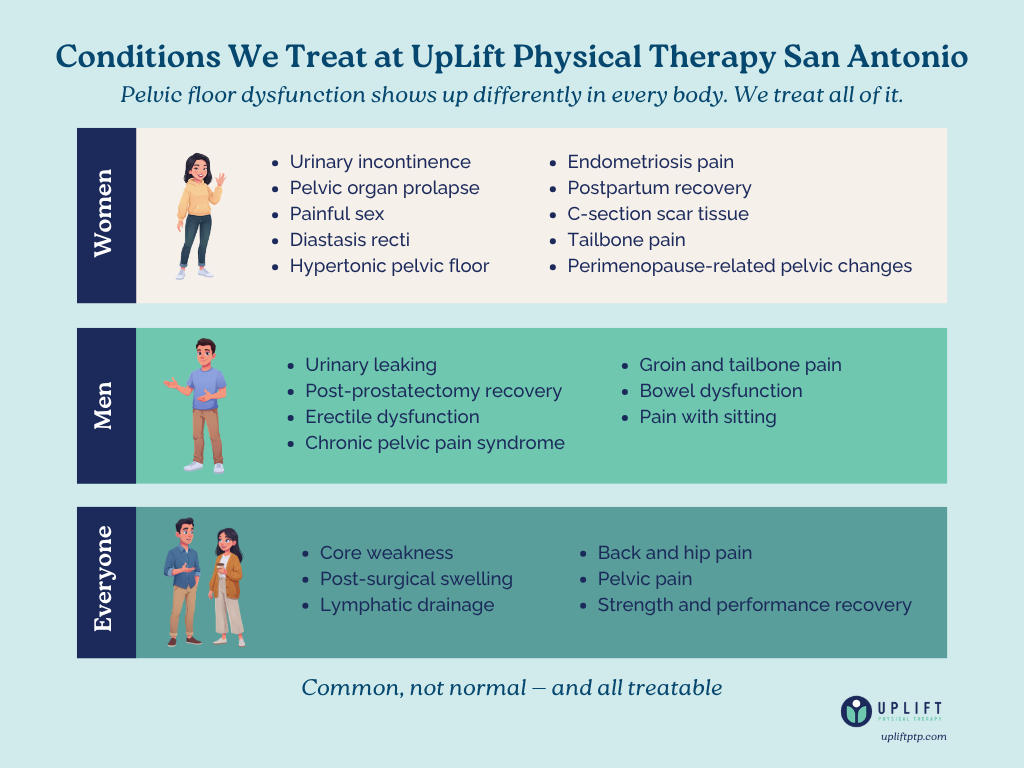
For women:
- Urinary leakage (stress, urge, or mixed incontinence)
- Pelvic organ prolapse
- Painful sex (dyspareunia or vaginismus)
- Diastasis recti — if you’re looking for diastasis recti PT in San Antonio or diastasis recti therapy in San Antonio, this is one of our most common and most treatable conditions
- Pregnancy-related pelvic girdle pain
- Postpartum recovery (vaginal delivery or C-section)
- Post-surgical recovery (hysterectomy, prolapse repair, and more)
- Perimenopause and menopause-related pelvic changes
- Endometriosis-related pelvic pain
- Interstitial cystitis
For men:
- Chronic pelvic pain
- Pain with sitting or groin pain
- Urinary leakage or urgency
- Erectile dysfunction and sexual health concerns
- Post-prostatectomy recovery
- Tailbone and hip pain
For all patients:
- Core weakness and instability
- Bowel dysfunction (constipation, urgency, incomplete emptying)
- Post-surgical scar tissue and recovery
- Orthopedic issues that connect to pelvic floor dysfunction (hip, low back, tailbone)
Not sure if your symptoms fit? That’s exactly what a free 15-minute consultation is for. We’ll tell you honestly whether we can help — and if we can’t, we’ll point you in the right direction.
Meet Your San Antonio Pelvic Floor Specialists
At UpLift, you’re not just getting physical therapy. You’re getting doctoral-level specialists who have dedicated their careers to pelvic health.
Our female pelvic floor therapists in San Antonio hold advanced certifications in pelvic floor rehabilitation, oncologic physical therapy, lymphedema therapy, orthopedic manual therapy, and dry
needling. They’ve trained beyond what’s required — because your pelvic floor deserves more than a generalist approach. And yes, we also have specialists trained specifically in male pelvic

floor conditions — one of the few clinics in San Antonio that does.
Every therapist at UpLift is committed to care that is:
- Clinical — rooted in the most current evidence and techniques
- Compassionate — no rushing, no dismissiveness, no “that’s just normal”
- Personalized — your plan is built around your body, your goals, and your life
You’ll find bios for each member of our team on our About page — including their training, specialties, and what drives them to do this work.
Pelvic Floor Therapy Near New Braunfels
If you’re located in New Braunfels, Schertz, Seguin, or surrounding areas, UpLift is a convenient option for specialized pelvic floor care. We’re located at 8818 Tradeway Street, San Antonio — easily accessible off 410 and Broadway, with plenty of parking.
Many patients make the drive specifically because pelvic floor therapy in New Braunfels, Texas is difficult to find at this level of specialization. When you’re looking for physical therapy in New Braunfels and need more than a generalist approach — whether that’s for prolapse, postpartum recovery, diastasis recti, or chronic pelvic pain — UpLift is worth the trip. We’d love to connect and see if we’re the right fit for you.
Frequently Asked Questions About Pelvic Floor Therapy in San Antonio
How much does pelvic floor therapy cost in San Antonio?
Pelvic floor therapy cost in San Antonio varies by clinic and care model. At UpLift, we’re a private-pay clinic, which means we don’t bill insurance directly. This allows us to provide fully personalized, one-on-one care without the limitations that come from insurance-driven protocols. Many patients find that the clarity of our pricing — and the speed of their results — makes private pay the right choice. We’re happy to discuss session fees and package options when you call.
Do I need a referral for pelvic floor physical therapy in San Antonio?
No. Texas is a direct-access state for physical therapy, which means you can book directly with UpLift without a doctor’s referral to start. This saves you time, money, and the frustration of navigating unnecessary steps. If your insurance or provider requires a referral, we’ll help coordinate that after your initial evaluation.
How often should physical therapy be done?
This depends on your symptoms, goals, and where you are in your recovery. Most patients start with weekly or twice-weekly sessions, then taper as they progress. Your therapist will give you a clear recommendation at your first visit — not a vague “we’ll see how it goes,” but an actual plan with a realistic timeline.
How many sessions will I need?
It varies depending on your symptoms, how long you’ve had them, and your goals. Many patients notice meaningful changes within the first few sessions. More complex conditions — like prolapse, post-surgical recovery, or long-standing pelvic pain — typically benefit from a longer plan of care. Your therapist will give you a realistic timeline at your first visit.
What should I wear to pelvic floor PT?
Comfortable, loose-fitting clothing you can move in. Think workout clothes or leggings — nothing you’d need to peel off. Your therapist may assess your movement and posture, so being able to move freely helps.
Is pelvic floor PT only for women who’ve had babies?
Not at all. Pelvic floor therapy helps people of all genders and life stages — including women who’ve never been pregnant, men dealing with pain or dysfunction, and anyone recovering from surgery or managing chronic pelvic symptoms.
Do you treat men at UpLift?
Yes. UpLift is one of the few pelvic floor clinics in San Antonio with trained specialists for male pelvic floor conditions. Our care for men is discreet, evidence-based, and built around your specific goals — whether that’s resolving chronic pelvic pain, recovering from prostate surgery, or improving sexual health.
Is the internal exam required?
No. Your comfort and consent guide every part of your care. If internal pelvic floor evaluation isn’t appropriate or you prefer not to include it, your therapist has many other tools and approaches to assess and treat your symptoms effectively.
Why Choose UpLift PT for Pelvic Floor Therapy in San Antonio?
When you’re searching for the best physical therapy in San Antonio for pelvic health, the difference comes down to specialization. Here’s what makes UpLift different:
Specialized, not generalist. Pelvic floor therapy is not a side service we offer — it’s everything we do. Our entire clinic, team, and approach is built around pelvic health.
One-on-one, every time. You will never be handed off to an aide or share a treatment space with another patient. Every session is with your licensed specialist.
Doctoral-level expertise. Our therapists hold Doctor of Physical Therapy degrees and advanced certifications in pelvic health, oncology, lymphedema, and orthopedic manual therapy.
No referral required to get started. Walk in, get assessed, get a plan. Texas direct access means we can see you now.
We treat everyone. Women. Men. Pregnant patients. Post-surgical patients. Perimenopause through older adulthood. All genders, all life stages.
We fix the root cause. We don’t just reduce your symptoms and call it done. We keep working until you’re back to exercising, having pain-free intimacy, and living without the constant mental weight of managing your body.
Ready to Start? Let’s Figure This Out Together.
You’ve probably been dealing with this longer than you should have. Maybe you’ve been told it’s just part of getting older, just part of having had kids, just something you manage. It isn’t.
Pelvic floor physical therapy in San Antonio at UpLift gives you real answers and a real plan — built around your body, your goals, and your life.
Start with a free 15-minute phone consultation. We’ll listen to your symptoms, answer your questions, and match you with the right therapist for your needs.
Or, if you’re ready to dive in, schedule your initial evaluation directly:
📍 UpLift Physical Therapy and Performance 8818 Tradeway Street, San Antonio, TX 78217 Off 410 and Broadway, near the airport | Free parking on-site